Thomas Moretti, axelity ag
Co-founder and Managing Director of axelity ag | Product strategist of the Swiss signing solution actaSIGN®
Three signature levels. 90% confusion. 0% clarity.
Warning: mild geek alert. But only briefly.
Switzerland and the EU/EEA have the same three relevant electronic signature levels: SES, AES, and QES. Switzerland is governed by ZertES; the EU and EEA are governed by the eIDAS Regulation. In practice, this often turns into a philosophical debate, even though the decision is usually quite pragmatic.
The real question is not: "What is the most secure signature?"
It is: Which signature level fits the document, the risk, and the statutory form requirement?
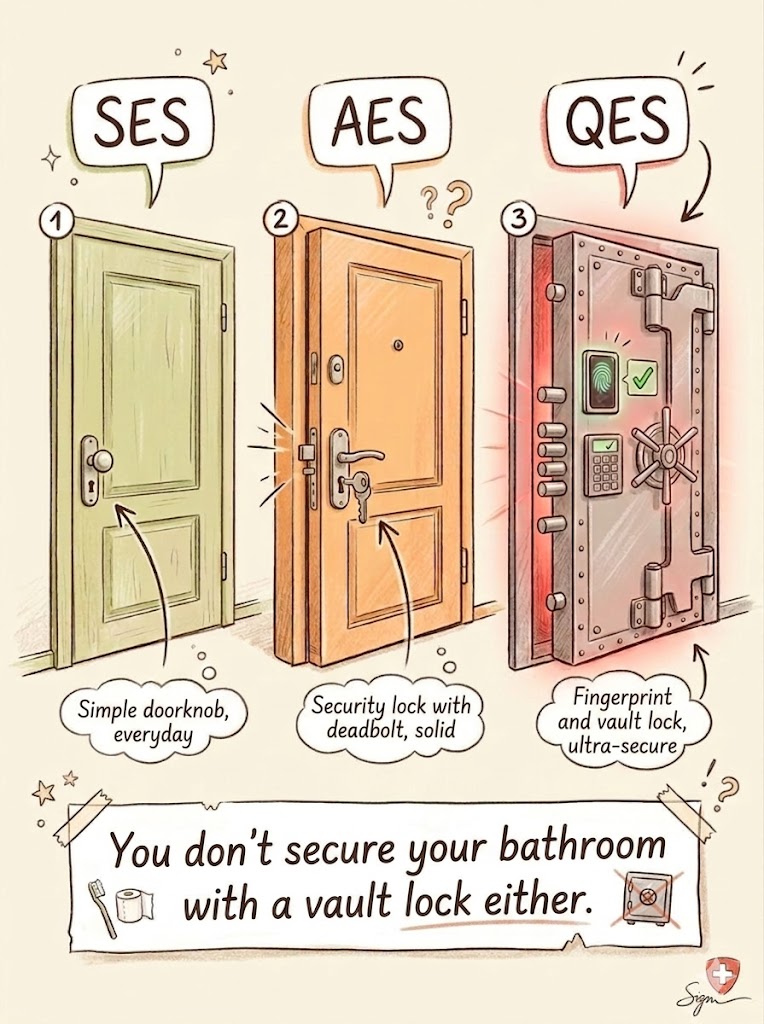
The Short Answer
If the law does not prescribe a special form, you usually do not need QES. The decision is then mainly about evidentiary value, identifiability, and process cost.
As a rule of thumb:
- Does the law require written form?
Yes: check QES. No: continue. - Is there an elevated liability or evidentiary risk?
Yes: AES. No: SES is often enough.
That is almost it.
SES: Simple Electronic Signature
The Simple Electronic Signature (SES) is the lowest level under ZertES and eIDAS. It does not require a qualified certificate or a complex identity verification process.
Typical examples:
- Internal approvals
- Offers
- Order confirmations
- Purchase orders
- Simple authorisations
- Documents with low dispute potential
SES is not "worthless". It is simply not designed for every risk level. For internal and straightforward business processes, that is often exactly right: low friction, low effort, fast cycle time.
AES: Advanced Electronic Signature
The Advanced Electronic Signature (AES) is the pragmatic middle ground. The identity of the signer is more verifiable, changes to the document are traceable, and the evidentiary value is significantly stronger than with a simple signature. That applies in both the Swiss ZertES context and the eIDAS area.
Typical examples:
- Purchase contracts
- Employment contracts
- Lease and tenancy agreements
- NDAs
- Acceptance of terms and conditions
- B2B contracts with moderate risk
This is where it gets interesting: many contracts that companies reflexively sign with QES do not legally require QES at all. AES can be fully sufficient if no statutory written form applies and the main concern is a solid evidentiary position.
QES: Qualified Electronic Signature
The Qualified Electronic Signature (QES) is the highest level. In Switzerland, it is legally equivalent to a handwritten signature under ZertES when the statutory requirements are met. In the EU and EEA, eIDAS also gives QES the equivalent legal effect of a handwritten signature.
It is the right choice when the law requires written form and you want to sign electronically instead of on paper.
Typical examples:
- Certain consumer credit agreements, depending on applicable national law
- Documents subject to statutory written form
- Cases where maximum evidentiary value is deliberately required
But QES is not simply "AES plus a little more security". QES means more effort: identity verification, qualified certificates, stronger authentication, and often more friction for the signer.
If that effort is not legally or risk-wise necessary, "better safe than sorry" quickly becomes expensive, slow, and unnecessarily complex.
Attention: Paper Can Still Be Mandatory
A common misconception: if QES is legally equivalent to handwritten signature, it should always be able to replace paper or every special form.
Unfortunately, no.
Some legal acts do not merely require a signature, but a special form. The details differ by country, but the logic is similar in Switzerland and the EU/EEA. Examples:
- Holographic wills: must be written and signed by hand.
- Real estate purchase agreements: require notarial authentication or a comparable special form in many jurisdictions.
- Sureties: are subject to special formal requirements and may trigger additional requirements depending on the constellation.
QES is strong. But it does not replace own-hand requirements, notarial authentication, or other special formal requirements.
Examples from Daily Business
Employment Contracts
Standard employment contracts in Switzerland are generally not subject to a form requirement under CO Art. 320. In many EU/EEA countries, standard employment contracts can also be concluded electronically unless a national special rule applies. For evidentiary reasons, AES is often sensible. QES can be used, but in many standard cases it is not mandatory.
Purchase Contracts and Orders
Purchase contracts and orders are often not subject to a form requirement. Depending on country, value, and risk, SES or AES is enough. For simple orders, SES often suffices; for higher contract value, AES is the sensible default.
Offers and Order Confirmations
Here too, the usual rule is: no form requirement. For many processes, SES is sufficient. If the offer carries higher legal or financial weight or is relevant across borders, AES can make sense.
Lease and Tenancy Agreements
Lease and tenancy agreements are regulated differently depending on country and contract type, but they are often possible without QES in daily business. Because of evidentiary value, duration, and potential disputes, AES is recommended.
Internal Approvals and Authorisations
Internal approvals rarely need QES. Most of the time, the goal is traceability inside the process. SES is sufficient in many cases.
Terms and Conditions
Terms and conditions do not automatically require QES. The context matters: how is consent captured, which law applies, what risk exists, and what evidence will you need later? In many cases, AES is a good standard; QES only where it is truly required.
The Real Problem: Reflexive QES
Many companies reflexively choose QES. For everything.
Because "better safe than sorry".
The result:
- Identity verification by video or app
- Additional steps for external signers
- Higher cost per signature
- More support questions
- Longer cycle times
And all of that for contracts where AES would be legally and practically sufficient.
That is not a security gain. It is process drag.
My Recommendation
Do not start with the signature level. Start with the document.
Ask:
- Is there a statutory form requirement?
- What happens if the signature is later disputed?
- How high is the commercial risk?
- How much friction is acceptable for the signer?
Then choose the lowest signature level that is legally and evidentially sound for the case.
For many companies, that means:
- SES for simple and internal processes
- AES as the default for relevant business contracts
- QES targeted where law or risk truly justifies it
The best signature level is not the strongest one. It is the right one.
Frequently Asked Questions
Which electronic signature levels exist in Switzerland and the EU/EEA?
Three signature levels are relevant in Switzerland and the EU/EEA: Simple Electronic Signature (SES), Advanced Electronic Signature (AES), and Qualified Electronic Signature (QES). Switzerland is governed by ZertES, while the EU and EEA are governed by eIDAS.
When is a Simple Electronic Signature sufficient?
An SES is often sufficient for internal approvals, offers, order confirmations, purchase orders, and other documents without statutory form requirements or elevated liability risk.
When is an AES recommended?
An AES is recommended for contracts with higher evidentiary or liability risk, such as employment contracts, purchase contracts, lease agreements, NDAs, or acceptance of terms and conditions. It makes identity more verifiable and strengthens the evidentiary position.
When do I need QES?
You need QES in particular when the law requires written form and you want to sign electronically instead of by hand. Examples include certain consumer credit agreements or other transactions subject to statutory written form.
Can QES always replace paper?
No. For some legal acts, paper or a special form remains mandatory, such as holographic wills or notarised real estate purchase agreements. The details depend on applicable national law. QES does not replace own-hand requirements or notarial authentication.
Further Reading
- Difference Between SES, AES, and QES — Electronic Signature Types Explained
- Electronic Signatures — Legal Framework and Practice
- The True Cost of a Paper Contract
- Compare Signature Qualities
Note: This article provides general orientation for companies in Switzerland and the EU/EEA and does not constitute legal advice. For form-sensitive, cross-border, or particularly high-risk transactions, the specific legal situation should be assessed case by case.